
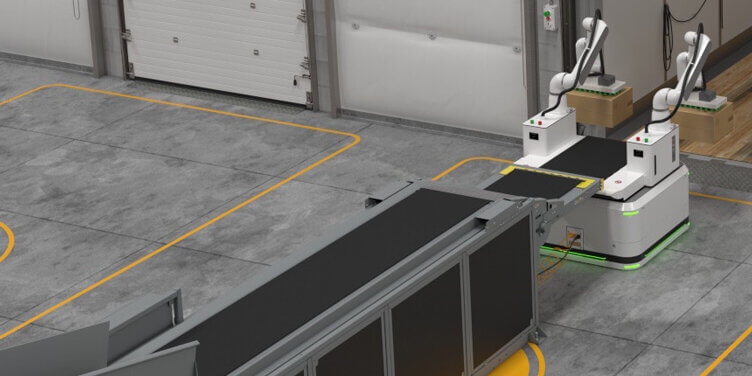
Everyone Talks About the Robot. Almost Nobody Talks About How It Gets Fed.
Spend a few minutes researching today’s warehouse automation market and you’ll find no shortage of discussions about robotics, artificial intelligence, machine vision, autonomy, machine learning, and software platforms.
What you are far less likely to find is a detailed explanation of how products actually arrive at the robot.
How are packages spaced before robotic interaction?
How is product flow managed during peak volume periods?
What controls the rate at which products arrive?
What happens after the robot completes its task?
These questions may sound simple, but they sit at the center of robotic system performance. Yet they are often overlooked in conversations about warehouse automation and robotic loading or unloading solutions. FAST’s robotics positioning research found that many robotics providers emphasize the robot, software, AI, and automation outcomes while providing relatively little discussion around package presentation, flow control, spacing, or conveyor system design.
The reality is that robots rarely operate in isolation. They operate within a larger material handling ecosystem. And that ecosystem matters.
The Robot Is One Component of a Material Flow System
Robotic systems typically perform a specific task exceptionally well:
- Picking
- Sorting
- Loading
- Unloading
- Depalletizing
- Identification
- Inspection
But the robot is only active during a small portion of a product’s journey.
Before a package reaches a robotic system, it must be:
- Transported
- Merged
- Metered
- Queued
- Positioned
- Presented
After the robotic interaction is complete, the product must continue moving through the facility without creating downstream bottlenecks.
This broader product movement system is what enables the robot to perform consistently in a real-world environment. FAST’s robotics strategy work describes this as the conveyor foundation that helps robotic systems perform safely, efficiently, and consistently in dock and warehouse operations.
Why Robotic Throughput Depends on Package Flow
One of the most common assumptions in automation planning is that robotic throughput is primarily determined by robotic cycle speed. In practice, two robotic systems with identical specifications can produce dramatically different results depending on the consistency of incoming product flow.
Consider what happens when:
- Packages arrive in clusters rather than evenly spaced intervals.
- Items are improperly oriented.
- Product gaps vary dramatically.
- Conveyor speeds fluctuate.
- Accumulation zones become congested.
In each scenario, robot performance is affected before the robot even touches the package. A robot can only process what arrives in front of it. If package delivery is inconsistent, throughput becomes inconsistent. This is why concepts such as controlled flow, gapping, metering, queuing, and package presentation are becoming increasingly important in robotic applications. FAST’s ARM™ technology positioning specifically identifies these capabilities as critical to helping support robotic performance and material flow consistency.
The Four Questions Every Robotics Project Should Answer
Organizations evaluating robotic loading, unloading, or sortation solutions should ask four fundamental questions early in the planning process.
1. How Does the Product Get to the Robot?
Many project discussions begin with robotic functionality without fully understanding how products will arrive at the point of interaction. Transport systems, conveyor design, and flow management all influence how effectively a robot can perform.
2. What Maintains Package Spacing?
Consistent spacing allows robotic systems to operate predictably. Without proper flow control, robots may encounter starvation, congestion, or inconsistent work cycles.
3. What Happens After the Robot Completes Its Task?
Robotic interaction is not the end of the process. Products must continue moving efficiently to packing, shipping, sortation, staging, or outbound operations.
4. How Are Exceptions Managed?
Not every package behaves as expected.
Operations must plan for:
- Irregular dimensions
- Product jams
- Damaged items
- Misalignment
- Flow interruptions
These operational questions were identified in FAST’s robotics content strategy work as some of the most important issues customers should evaluate when considering automation projects.
The Hidden Connection Between Conveyor Design and Robot ROI
Robotic investments are often justified using throughput gains, labor savings, or productivity improvements. However, these projected benefits depend on more than the robot itself. Successful automation requires a material handling infrastructure capable of supporting robotic performance.
Factors such as:
- Product presentation
- Package spacing
- Throughput balancing
- Equipment integration
- Flow consistency
can significantly influence the return generated by an automation project.
A highly capable robot connected to an inconsistent flow system will not produce the same results as that same robot operating within a well-designed material handling environment.
This concept aligns closely with FAST’s “Feed the Robot” positioning strategy, which recognizes that robotic systems rely on dependable and predictable product movement throughout the operation.
Why Conveyance Is Becoming a Competitive Advantage
Historically, conveyor systems were often viewed as infrastructure. Necessary? Yes. Strategic? Not always. That perception is changing. As facilities pursue robotics, automation, and modernization initiatives, conveyance is increasingly becoming a critical performance layer.
Today’s material handling systems influence:
- Throughput
- Labor efficiency
- Equipment utilization
- Package presentation
- Automation readiness
- Dock productivity
Organizations looking to future-proof operations are beginning to evaluate conveyor systems not simply as transportation equipment, but as platforms that support broader operational outcomes.
FAST’s customer segmentation work identifies throughput improvement, labor reduction, dock utilization, facility modernization, and automation initiatives as some of the primary business drivers behind investment decisions.
The Future of Warehouse Automation Will Be Built on Flow
The next generation of warehouse automation will continue to produce smarter robots, better software, more sophisticated AI, and greater levels of autonomy. But as automation technology advances, one reality is unlikely to change: Products will still need to move. They will still need to be presented, spaced, controlled, and delivered to the point of interaction. They will still need to move efficiently before, during, and after robotic engagement.
The organizations that achieve the greatest automation success may not simply be the ones with the most advanced robots. They may be the ones that best understand the entire material flow system supporting those robots. Because in the end, automation performance begins long before a robot touches a package. And that story starts with flow.